When a commercial HVAC cleaning project goes out to bid, the quality of the request for proposal can have a direct impact on the quality of the work received. A vague RFP that simply asks contractors to “clean the ductwork” can result in inconsistent bids, unclear expectations and major differences in what each contractor actually includes.
For building owners, facility managers, engineers, hospitals, schools, universities, manufacturers and other commercial properties, a detailed HVAC cleaning specification creates a common standard for bidders. It defines the system components to be addressed, contractor qualifications, cleaning methods, containment requirements, documentation and the level of cleanliness expected at completion.
The National Air Duct Cleaners Association (NADCA) publishes a General Specification for the Cleaning of Commercial HVAC Systems specifically to help building owners, managers, engineers and specifiers develop project requirements. NADCA describes the document as a starting point that must be customized to the unique HVAC systems and conditions of each building.
Why a Detailed HVAC Cleaning RFP Matters
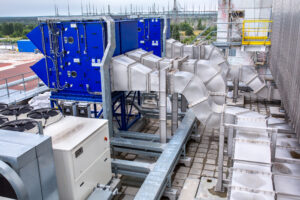
Commercial HVAC systems can include extensive supply and return ductwork, air-handling units, coils, fans, plenums, dampers, diffusers, grilles and other airside components. If an RFP does not clearly identify what is included, contractors may price completely different scopes of work.
A strong specification helps create an apples-to-apples bidding process. It also gives the owner a written basis for evaluating contractor qualifications, project execution and final cleanliness instead of relying only on the lowest bid.
1. Clearly Define the Scope of Work
The RFP should identify exactly which HVAC systems, air-handling units, zones and components are included. Drawings, equipment schedules and available system information should be provided whenever possible.
Depending on the project, the scope may include supply and return ductwork, air-handling units, fan sections, coils, drain pans, plenums, registers, grilles, diffusers and other accessible airside surfaces. The specification should also identify exclusions so bidders understand what is—and is not—part of the contract.
2. Reference the Appropriate NADCA Standard
A commercial HVAC cleaning RFP should establish the performance standard expected for the work. NADCA’s ACR, The NADCA Standard for Assessment, Cleaning and Restoration of HVAC Systems, is an industry benchmark for professional HVAC cleaning.
The current ACR framework addresses HVAC component inspection, engineering controls and containment, negative air pressure, source-removal cleaning, safety planning and cleanliness verification. Referencing the applicable standard helps establish consistent expectations for how the work should be performed and verified.
3. Establish Contractor Qualifications
Not every company with a vacuum is qualified to perform a large commercial HVAC cleaning project. The RFP should state the experience and credentials required of bidders.
Specifications may address NADCA membership, appropriate certification such as an Air Systems Cleaning Specialist (ASCS), relevant commercial experience, trained personnel, required equipment, insurance and references for comparable projects. For hospitals, schools, industrial plants and other complex facilities, owners may also want demonstrated experience working in similar occupied environments.
4. Require a Pre-Project Assessment
Before work begins, the contractor should understand the HVAC system configuration, access limitations, contamination conditions and operational constraints. A pre-project assessment can help identify access requirements, sensitive areas, system shutdown needs and other conditions that may affect the cleaning plan.
This is especially important in older buildings, healthcare facilities, campuses and industrial environments where HVAC systems may have been modified over time.
5. Specify Source-Removal Cleaning
The RFP should clearly describe the required cleaning objective and methods. Professional HVAC cleaning is based on removing accumulated contamination from system components—not simply treating, coating or blowing debris from one area to another.
Vacuum collection equipment should be appropriately sized for the system and used with agitation or other suitable cleaning methods to dislodge and capture debris. Cleaning methods should not damage ductwork, coils, insulation or other HVAC components.
6. Include Negative-Pressure Requirements
Controlling dislodged debris is a critical part of HVAC cleaning. NADCA standards call for maintaining the portion of the HVAC system being cleaned under appropriate negative pressure relative to surrounding occupied spaces.
The specification should address vacuum collection, filtration or outdoor exhaust requirements and verification of negative pressure during cleaning. This is particularly important in occupied buildings where controlling contaminant migration is a priority.
7. Define Containment and Occupant Protection
Commercial projects may require protective coverings, temporary barriers, HEPA-filtered air-cleaning equipment or other engineering controls depending on the facility and project conditions.
An RFP should identify special requirements for occupied areas, sensitive equipment, patient-care spaces, classrooms, laboratories, manufacturing processes or other environments where dust migration and work-area control are especially important.
8. Address Access Openings and System Restoration
Many commercial systems require service openings so technicians can reach internal duct and HVAC surfaces. The RFP should establish how access openings will be created, how existing access will be used and how openings will be properly closed or restored after cleaning.
Any removal and reinstallation of registers, diffusers, panels or other components should also be clearly assigned within the project scope.
9. Include Coils, Drain Pans and Air-Handling Components Where Appropriate
A duct-only specification can overlook important HVAC components. Dirty cooling coils, fan assemblies, drain pans and air-handling unit interiors can contain significant buildup and may affect overall system cleanliness.
The project assessment should determine which components require cleaning, and the RFP should clearly state the expected methods and scope for those components.
10. Address Cleaning Products and Chemical Applications
If cleaning agents or other products may be used, the specification should establish approval and documentation requirements. Products should be used only where appropriate and in accordance with manufacturer instructions and applicable requirements.
Owners should understand what products a contractor proposes to introduce into the HVAC system and why they are necessary. Chemical application should never be used as a substitute for proper source-removal cleaning.
11. Require Cleanliness Verification
An RFP should answer an important question before the project begins: How will the owner know the system is clean?
NADCA’s ACR Standard includes cleanliness-verification methods. At a minimum, components within the scope should achieve the specified level of cleanliness, and verification should occur after cleaning and before the system is returned to operation. For certain projects, the owner or consultant may specify additional verification requirements.
12. Define Documentation and Closeout Requirements
Commercial facility teams often need a record of completed work. The RFP can require pre- and post-cleaning photographs, identification of systems and components cleaned, documentation of unusual conditions, verification results and a final project report.
For large campuses or phased projects, documentation can also help facility teams track which systems have been completed and support future maintenance planning.
13. Address Scheduling, Phasing and Facility Operations
For hospitals, schools, manufacturing plants and other facilities that cannot easily shut down, project scheduling should be part of the specification—not an afterthought.
The RFP should identify permitted work hours, shutdown windows, occupied-area restrictions, required notifications and whether the project must be phased by building, floor, department, air-handling unit or system. Advance planning can significantly reduce operational disruption.
14. Include Facility-Specific Safety and Coordination Requirements
Every building is different. Healthcare facilities may have infection-prevention requirements. Industrial facilities may have process hazards or restricted areas. Schools may require work to occur outside occupied hours. The RFP should incorporate applicable facility policies, safety requirements, permits and coordination procedures.
Avoid Writing an RFP That Focuses Only on Price
Price matters, but a low bid is difficult to evaluate when contractors are not bidding the same scope. One contractor may include complete air-handling unit and duct cleaning, containment and verification while another may price only accessible ductwork.
A well-developed specification makes bids easier to compare by establishing the minimum requirements before pricing is submitted. Contractor qualifications, cleaning methods, containment, system protection, documentation and verification should all be considered alongside cost.
Use NADCA’s General Specification as a Starting Point
NADCA’s General Specification was developed to help owners, managers, engineers, architects and other specifiers organize commercial HVAC cleaning requirements. It follows a structured specification format and addresses areas such as administrative requirements, submittals, contractor qualifications, products, execution, cleaning methods, equipment and quality control.
However, a template should not simply be copied without evaluating the building. NADCA specifically notes that its General Specification must be modified to account for the unique system variations and requirements of each project. A successful commercial HVAC cleaning project depends on both a well-developed specification and selection of a qualified contractor.
Advanced Air Duct Cleaning: Commercial HVAC Cleaning Experience Since 1964
Advanced Furnace and Air Duct Cleaning Inc. works with commercial, institutional and healthcare facilities on professional HVAC and air duct cleaning projects. Our team understands that large projects require more than cleaning equipment—they require coordination with facility representatives, careful planning, qualified personnel, appropriate containment and a clearly defined scope.
We provide commercial HVAC cleaning throughout New Jersey, Northern Delaware, Eastern Pennsylvania and Staten Island and can work with facility managers, engineers, contractors and project teams to review HVAC cleaning requirements and plan the work around building operations. Developing an RFP or preparing a commercial HVAC cleaning project? Contact Advanced Air Duct Cleaning to discuss your building, system scope, scheduling requirements and project specifications.