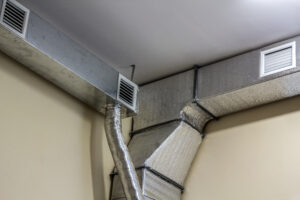
Exposed insulation edge joints inside internally lined HVAC ductwork are more than a cosmetic concern. As conditioned air moves across unsealed insulation edges, fibers can gradually become airborne and circulate throughout the ventilation system. Left unaddressed, exposed edge joints may contribute to declining indoor air quality, reduced HVAC efficiency, and increased wear on critical system components.
Older duct liner materials may contain flame retardants, formaldehyde-based binders, or other volatile organic compounds (VOCs), depending on the product and date of manufacture. Although not every duct system contains these materials, aging insulation should be professionally evaluated to determine its condition and the most appropriate corrective action.
How Exposed Insulation Edges Affect HVAC Airflow
Exposed insulation edges also create turbulence within the duct system. This disruption to smooth airflow can increase static pressure, forcing the blower motor to work harder to move conditioned air throughout the building. Higher static pressure can reduce energy efficiency, increase operating costs, and contribute to premature wear of blower motors, bearings, and other HVAC components.
What Happens When Duct Insulation Begins to Deteriorate
Over time, high-velocity airflow may begin lifting insulation away from the sheet metal substrate. As the adhesive bond weakens, sections of insulation or loose fibers can detach and travel downstream through the duct system, creating additional maintenance concerns while reducing the effectiveness of the duct liner.
How HVAC Insulation Encapsulation Can Help
Professional encapsulation is an effective solution when the insulation remains structurally suitable for preservation. A specialized HVAC-approved encapsulant seals exposed insulation edges, helps reduce fiber release, reinforces the insulation surface, and protects against additional deterioration. This process can improve indoor air quality, maintain proper airflow characteristics, and extend the useful life of the duct system when replacement is not required.
Professional HVAC Duct Inspections and Encapsulation
Advanced Air Duct Cleaning performs detailed HVAC inspections to identify exposed insulation edge joints and other duct system deficiencies. Our experienced technicians provide recommendations based on industry best practices and professional encapsulation services when appropriate. If you’re noticing deteriorating duct liner, airflow issues, or indoor air quality concerns, contact our team to schedule an inspection and determine the right solution for your system.
Professional Disclaimer
Exposed insulation edge joints have been observed within the internally lined ductwork. As air moves across these exposed edges, insulation fibers may become airborne and circulate throughout the HVAC system. Depending on the age and composition of the insulation, these fibers may contain substances such as flame retardants, formaldehyde, or other volatile organic compounds (VOCs). Airborne insulation fibers may also cause irritation to the eyes, skin, nose, and throat in sensitive individuals.
In addition to potential indoor air quality concerns, exposed insulation edges disrupt airflow and increase static pressure within the HVAC system. Elevated static pressure can reduce system efficiency and place additional strain on the blower motor and other components, potentially contributing to premature wear and reduced equipment life. High-velocity airflow can also lift and separate the insulation from the sheet metal over time, allowing sections of insulation or fibers to break free and travel downstream through the duct system.
Encapsulation is recommended to seal exposed insulation edges, help prevent further deterioration and fiber release, maintain proper airflow, improve indoor air quality, and protect the HVAC system from unnecessary wear.