
You had the air ducts cleaned, yet dust seems to be back almost immediately. A leaky return duct is one possible reason, particularly when the duct runs through an attic, crawlspace, basement, or garage. But the pattern of dust matters: dust on furniture, dust collecting around a return grille, and debris blowing from a supply register point to different questions. Before paying for another cleaning, find out where the particles are coming from.
How a Return Duct Leak Can Bring in Dust
Return ducts pull air back to the heating and cooling equipment. If a return duct has a gap in an unfinished space, it can draw in air carrying insulation fibers, construction dust, or other particles. Depending on where the leak is relative to the filter, that air may bypass filtration before moving through the system. The U.S. Department of Energy identifies return-side duct leakage as a path for particles from building cavities to enter the air distribution system.
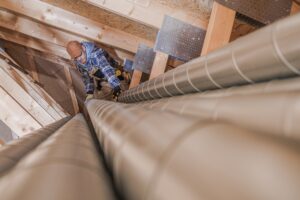
An inspection should look for loose connections, damaged ducts, open building cavities used as returns, and gaps near the air handler. Duct leakage testing can help confirm whether air is entering through the duct system. If leaks are found, accessible joints may be sealed by hand, while Aeroseal may address suitable hidden leaks from inside the ductwork. Disconnected or damaged sections need repair.
Check the Filter and its Fit
A filter cannot capture air that passes around it. The U.S. Environmental Protection Agency recommends checking that filters are present, replaced regularly, and fitted so air cannot bypass them through gaps around the holder. A filter that clogs unusually fast may be a clue that the system is drawing in a high particle load, but it does not prove which source is responsible.
Consider What Happened During the Cleaning
If debris is visibly coming from a supply register soon after service, ask the cleaning company to review the completed scope and show what was cleaned. Supply and return ducts, plenums, and affected HVAC components may all need attention when a system is contaminated. A visual check of accessible areas and the company’s documentation can help separate material left behind from new material entering afterward.
Dust on Surfaces May Come From Somewhere Else
Everyday activity, open windows, pets, fabrics, outdoor air, and renovation work can add particles to a home. EPA notes that dust on a return grille is common and does not, by itself, show that the ducts contain heavy deposits. If dust mainly settles on furniture throughout the house, look at those other sources and housekeeping patterns as well as the HVAC system.
Notice where and when the dust appears. Is it concentrated around a particular supply register? Does it increase when the system fan runs? Did it start after attic work or construction? Does a filter collect unusual debris? These observations give a technician more useful clues than the general statement that the house feels dusty.
Cleaning and Sealing Solve Different Problems
Cleaning removes material already inside the system. Sealing closes air leaks that may let new particles enter or conditioned air escape. When both contamination and leakage are present, a professional should explain the sequence and the reason for each service. Neither service guarantees a dust-free home, and repeated cleaning without correcting an active entry path may leave the underlying problem in place.
Find the Source Before Repeating the Service
Advanced Air Duct Cleaning can review the condition of your ducts, the filter area, and the signs of return-side leakage. If testing and inspection support it, we can recommend cleaning, duct repair, or Aeroseal duct sealing. Contact our team to investigate why dust is returning and what work would address the cause.